Saturday, February 9, 2013

He Did What??

Have you heard the one about Ole..?

                                    
When you hear that introduction, you know that Ole is going to be the brunt of the next Dumb Norwegian joke, but there are some “Oles” that are not funny, and these “Oles" are worth mentioning.

Have you heard of Ole Roemer? “Well, Ole was out looking at the stars when he noticed..” No joke here! In 1644, Ole was born in the town of Arhus, Denmark, becoming an university professor in astronomy. One of his interests was the observance of the moons of Jupiter. In time, he noted a peculiar time difference in the eclipses as they revolved. Measuring the distances related to the earth, he created the measurement that resulted in the calculation of the speed of light. Distance from earth to all planets are measured by Ole's discovery.
----------
                                   

Everyone has had an experience with a favorite construction toy created by another “Ole". Ole Kirk Christiansen, another Dane, born in Billund, Denmark became a master carpenter. In 1932, he was making some toys for his son who enjoyed playing with the left-over pieces of wood. His son began building  little creations, giving Ole the idea of making wooden blocks for the boy. Soon, these blocks became Ole’s most successful product. In 1934, Ole gave the new project the name formed from the Danish words “ Leg godt” meaning “play well”..The new product became known to us as “LEGOS”.  
-----------
                                                                              
Another Ole wanted to get some ice cream for his lady-friend and rowed across the lake to the ice-cream parlor. The day was very warm and by the time he returned, the  ice-cream was melted. Again, no joke, it really happened.This Ole was born in Norway and immigrated to the US with his farmer parents. Not interested in farming, Ole became an expert in motors, working with a manufacturing company of farming equipment. After many attempts, we know the famous outboard Evinrude motor that is famous today.
----------
                                                             
There are many Scandinavian inventors. Some are rarely mentioned, but very important to our society. It would be difficult to understand how we could possibly exist without the work of Rasmus Mailing Hansen. Every American child, youth, and adult  with their thumbs working a keyboard is using a variation of the “Hansen Writing -Ball Letter” machine. It would be very interesting to see users working this key layout!
  
Rasmus was born in Denmark in 1835. The Hansen Writing Ball was invented in 1868 by the Reverend and principal of the Royal Institute for the deaf-mutes in Copenhagen. The writing ball was first patented and entered production in 1870, and was the first commercially produced typewriter. (No QWERTY keyboard, yet!) Rasmus was a priest, inventor, and a scientist. 

                               --------------------
Four Finnish students were working on a “Master Project’ called “Erwise” at Helsinki University. Erwise was a pioneering data management system, and the first commonly available as a graphical user interface, language well-known to computer progammers today  . 
Programming language used for the WWWeb
---
How could we exist without it?!The development of Erwise halted after the students graduated and went on to other projects. Tim Berners-Lee, a British computer scientist  traveled to Finland to encourage the group to continue the project, becoming the creator of the World Wide Web released in April 1992. Although a Brit became the creator, the project began in Finland.
-------------
 Even at the movies, we are asked to "turn off our phones". Today, everyone seems to have an electronic device in their hand or in their pocket. Eric Magnus Tigerstedt (August 4, 1887 – April 20, 1925) was one of the most significant inventors in Finland at the beginning of the 20th century. In 1917, he filed a patent for what he described as a "pocket-size, folding telephone with a very thin carbon microphone". Sound familiar?
----------

When a new revolutionary "fastening device" was introduced , the public was skeptical.
"Why ditch buttons, hooks, and clasps", they asked? "Do clothes really need newfangled technology?"

Gideon Sundback was a Swedish-American electrical engineer, born in April 24, 1880, Jönköping Municipality, and became known due to his work in the development of the zipper. Several primitive zippers existed before 1914, but they were awful. Early designs jammed and pulled apart easily. They involved sharp hooks looping together, instead of Sundback's method of tight and secure metal fasteners. Sundback gets credit for inventing the zipper, because he created the first practical and reliable design. When the "Hookless No. 2" debuted in 1914, people didn't care. It was a quick-fastening device. Most still work!
-----------------------

There are many other Scandinavian inventions, too numerous to mention at this time!
Everyone recognizes the name Hans Christian Anderson,  Albert Nobel, and several others who have added some much to our  lives. The name of Borge Rosenbaum, the Clown Prince of Denmark has given everyone laughter and joy whenever he is seen or heard. Better known as Victor Borge, everyone enjoys his musical expertise and his well-known invention of “Phonetic Punctuation” as he reads using the commas, periods and grammatical marks with vocal emphasis.                                                           
Victor Borge

                                 We have been blessed with our Scandinavian heritage.
No joke!

Sunday, January 27, 2013

Ready...3...2...1...

Winter is definitely here to stay for some time, and sportsminded people are taking advantage of some free time to enjoy the outdoors. Ski jumping hills have been groomed, and athletes have been training for the annual winter events.

 For the more adventurous skier, the world’s best ski jumpers have gathered at Vikersund, southwest of Oslo, for this winter’s Ski Flying World Championships.  Years of hard work and training are behind every one of the young men taking part in this tournament.While there are several Olympic-style ski-jumping sites, the most famous is Norway's  Holmenkollen Ski Jump which  has been setting the standard for Norwegian skiing for over 100 years.
 -----------------
 The first ski jumping competition took place on 31st January 1892. .Oslo’s newly remodeled Holmenkollen Ski Jump opened just in time for last winter’s Nordic Skiing World Championships, after enormous budget overruns and political controversy. Now it’s apparently full of construction mistakes and deficiencies, and maintainance costs increase. Newspaper Aften has  reported that a long list of problems had cropped up, but the sport goes on.
The first widely known ski jumping competition was the Husebyrennene, held in Oslo in 1879, with Olaf Haugann of Norway setting the first world record for the longest ski jump at 20 metres. The annual event was then moved to Holmenkollen in 1892, and Holmenkollen has remained the pinnacle of ski jumping competition.
-------------
Skiing has also been a staple of Nordic winter activity. Skis were necessary to “walk on the snow” to hunt or move anywhere in the rural areas. Earliest “skis” were long boards that were pushed by the feet, unattached to the boards, making turns impossible until someone designed a foot connection to the ski.

One of the first recorded advances in binding design was made by Sondre Norheim, the "father" of modern skiing. His invention was a binding utilizing a leather toe strap that was fastened tightly with a buckle, and a heel strap of small birch roots twisted into a rope, allowing the ski to be lifted from the snow and maneuvered.

Sondre Auverson  Norheim was born at Øverbø, a little cotter’s farm, and raised in Morgedal in the municipality of Kviteseid in Telemark. Skiing was a popular activity in Morgedal. Spectators watchng Sondre leap from shed roofs to the snow might have questioned his sanity, but ski-flying and the sport of ski-jumping was born..
----------------------
The new skiing activity was not without accidents.Norwegian ski jumping star Tom Hilde took a bad spill during the annual New Year’s week of competition in the Alps. Hilde had been in first place when he took a bad fall at Oberstdorf  while in competition. The 24-year-old was quickly back on his feet, to talk to NRK on Sunday.
“I’ll just have to use the time I have to make a comeback, or prepare for next season.” Hilde told reporters after being released from the hospital.
--------------
A Telemark landing
After each jump, competitors are judged by five judges, who are based in a tower to the side of the expected landing point. They can award up to 20 points each for style based on keeping their skis steady during flight, balance, good body position, and landing. The highest and lowest style scores are disregarded, with the remaining three scores added to the distance score. Thus, a perfectly scored K-120 jump - with at least four of the judges awarding 20 points each - and the jumper landing on the "K-point", is awarded a total of 120 points. In January 2010, a new scoring system was introduced to compensate for variable outdoor conditions.
-----------------
Snowflake Skihill
Meanwhile, back here in the USA, A southwestern Wisconsin community is hosting their annual Ski-jumping event.Westby, Wisconsin , a well-known Norwegian community plays host to jumpers during their 2013 Snowflake Ski Jumping Tournament, February 1st and 2nd. This annual event is part of the US Cup schedule that includes competition in several Midwestern states.Approxmately twenty-five national and international athletes are expected to be in the competition at Westby, arriving from Poland,Canada, and Norway and the United States.
--------------------
Snowflake Ski Complex in Westby, Wi.
Westby’s Snowflake Ski Club was organized in 1922 by a group who thought the community should have such an event, due to Westby’s strong Norwegian heritage. Organizers originally tried to buy some metal jump scaffolding,  but found the cost too expensive. So, they decided to build the scaffolding from wood. They ordered 10,000 feet of 1-by-4 and 1-by-6 boards and went to work. It has been said that “They didn’t really know much about building a ski jump, but just observed the way the hill went, and built the jump.” Some of the supports were tied to trees to help hold them up. These  ski-jumping events have created a tradition that has gone on since 1923, and has put Westby on the international ski jump map.
Opening ceremonies are scheduled for 7 PM, February 1st. The tournament  has added attractions  featuring night ski-jumping events with fireworks and entertainment between jumping events.
-------------
Besides the food offerings onsite, a local Westby Church will be serving a special treat for hungry visitors. At 11 AM, February 2nd,  the main-street church basement doors will open for the traditional lutefisk dinner, complete with lutefisk, meatballs,potatoes, rutabagas, and all the expected Norwegian trimmings topped off with Norwegian pastries. An alternative dinner,  a cheaper version for those who come for the excellent meal, will be for  those who, for some reason, omit the lutefisk.

                      There IS something to do on a snowy February Day!

Thursday, January 17, 2013

Stop!, or I'll......

The ending of this declaration depends upon the location of the person making the declaration!
As you travel through Scandinavia and Europe, you are expected to adhere to the rules of the country. While most countries have law-enforcement officers wearing side-arms, others do not. Norway is one of only three Western European countries lacking a fully armed police force. At the present time, only "beat police" officers in patrol cars have immediate access to weapons.
  By law, however, they have to remain unloaded and locked in a box in the car unless authorization is given.Some experts worry that arming police officers would only lead to an escalation of violence as criminals become armed. However, there was little that Norwegian police could do when faced by a heavily-armed gunman, who killed 77 in the August, 2012 massacre, swaying public opinion on the "unarmed" policy.
----------------


Norway has a large population of hunters. Semi-automatic and bolt action rifles, as well as shotguns, make up the better part of the guns in civilian homes. There is a total ban on automatic weapons for civilians, unless they fall into the collector category. Modification of semi-automatic guns into fully automatic without the consent of the police is a felony crime.
 ----------------
 Norway's neighbor, Sweden, began requiring its officers to carry guns in 1965.In one incident, numerous shots were fired by Swedish police after  robbers opened fire towards them during a jewelry heist in Södertälje, Sweden. Two plain-clothed policemen were the first to arrive to the scene 3 minutes after the first 112-call was received When the  robbers, armed with  automatic weapons opened fire on officers, the  robbers were immediately shot and subdued by the armed police.
---------------
 Other incidences require less violent reaction. No one was arrested during an  incident in Vallsta, 180 miles north of Stockholm this Christmas season. Police in Sweden had to intervene after a  visitor to a spa and conference center grew angry because a visiting Santa Claus was wearing a gray instead of red costume. Police said, in a brief statement, that the foreign guest grew agitated over the Santa outfit and argued with the center's staff. They did not say where the foreigner was from, and no armed action was reported.
---------------
 In Iceland all hand guns are banned. Buyers have to be 20 years old to be able to buy and use a rifle or shotgun. Each year, it is necessary to enter a lottery that determines if you get a hunting permit that year.
Icelanders mainly hunt for reindeer and ptarmigan.
---------------
In Denmark,hand guns are also banned unless you are licensed, and you can only get that license if you compete in tournaments, and the guns have to be kept in a safe at the club where you practice.
In order to get a permit to own a rifle, the buyer is required to participate in a course that takes 3 months to complete.
---------------
Switzerland practices universal conscription for their armed forces, which requires that all able-bodied male citizens keep fully automatic firearms at home in case of a call-up. Every male between the ages of 20 and 34 is considered a candidate for conscription into the military. During their enrollment in the armed forces, these men are required to keep their government-issued selective fire combat rifles and semi-automatic handguns in their homes.
--------------


Here, in the United States, a  United Nations report states that the US ranks number one in civilian ownership of firearms. The debate over gun ownership has become an important issue due to several individuals entering public buildings with assault weapons, killing defenseless school-students and movie-goers. Gun-owners defend their right to own weapons based on the Second Amendment to the US Constitution, which reads in part: A well regulated Militia, being necessary to the security of a free State, and the right of the people to keep and bear Arms shall not be infringed. This has remained unchanged since the adoption of the constitution in 1791, and is well-supported by The National Rifle  Association (NRA) and it's members. Currently, the US President has issued several official orders to re-instate an assault weapon ban that expired in 2004, while establishing stricter rules closing some loopholes in gun-sale policy.
---
Of high priority is the ban of the favorite AK-47, a Russian-made military weapon that is so popular and simple to operate, that sources have noted that children can be taught to use this weapon in a single hour.
--------------------
In this January 10, 2013 report: "U.S. life expectancy is lowest among wealthy nations due to disease, and violence. Not only do Americans live shorter lives than people in other wealthy nations, but they suffer more violent deaths compared to their peer countries, according to a report released Wednesday by two of the nation's leading health research institutions".

The debate rages on.

Wednesday, January 2, 2013

Getting The "Post-Christmas Blues"?

The holiday excitement has ended and a long winter has become a reality.

Winter days and nights can become dreary, but things are happening!

 If you are looking for "Something Different" to do, check out Hayward, Wisconsin this winter. The American Birkebeiner celebrates its 40th Anniversary  February 21-23, this year. A total of 10,000 skiers will ski the American Birkebeiner 50K Skate and 54K Classic races, the 23-kilometer Kortelopet  races, and the Prince Haakon 12K

Youngsters may also take part in a range of youth events. In 1206, Birkebeiner skiers, so called for their protective birch bark leggings, skied through the treacherous mountains and rugged forests of Norway's Osterdalen valley during the winter of 1206, smuggling the son of King Sverresson and Inga of Vartieg to safety. The annual race requires that adult skiers must carry a pack weighing the equivalent of this young child in memory of this rescue.....Wax your skiis and away you go!
----------------

Leaders of the Pack
If you'd prefer riding in luxury, You can experience the Iditarod from your own personal front row seat in the sled of an Iditarod Musher .This opportunity is a sled-ride from the starting line in Anchorage, Alaska for eleven miles and be part of the race!..The Iditarod Trail Sled Dog Race is an annual long-distance sled-dog race  in early March from Anchorage to Nome. Mushers and a team of 12–16 dogs cover the distance in 9–15 days. The Iditarod began in 1973 as an event to test the best sled dog mushers and teams, but evolved into today's highly competitive race. It may become cold, at times.Teams frequently race through blizzards causing whiteout conditions, sub-zero temperatures and gale-force winds which can cause the wind chill to
 reach -100 °F. Bundle up!
---------------

Robert Sørlie (born 1958) is a two-time Iditarod champion Norwegian dog musher and dog sled racer from Hurdal.  In 2003, he became the only non-American to win the 1,049-mile Iditarod Trail Sled Dog Race across Alaska, U.S. He won it again in 2005.
 ----------------

Or, if you happen to be in Norway after Christmas, you could sign up for a vacation trip that includes mushing your  team dog sledding trip this winter, traveling at high speed across the Norwegian wilderness.  This is a unique lifetime experience that lasts usually a week, with different levels, for beginners, intermediate and experts. While traveling throughout the Country, you can get a day off , while tour guests can play in the snow (go skiing, snowmobiling, etc.) and the dogs can relax. Get a taste of what life was like in the old days, when dog sledding was a much more common mode of transportation for many.
------------------
And where to stay overnight? Visit the Ice Hotel in Norway, kept at a constant temperature of around -4 to -7 degrees centigrade. With 30 bedrooms and two suites you will be cozy during the night with a sleeping bag that can keep people warm up to extreme temperatures of -30 degrees centigrade, and sleep on bed made from a genuine reindeer hide.
 ----------------
" I got one!"
 While you are visiting Sami Country, try some native Ice-fishing! Traditionally, once you drill a hole in the ice large enough for your bait, you then lie on reindeer skin placed on the ice and look through the hole at  crystal clear waters to see your bait and the unsuspecting fish swimming by.

                                                 ------------------
However, there are warmer sports to enjoy this winter..Bring your swimming suits..The Blue Lagoon geothermal spa is one of the most visited attractions in Iceland. The steamy waters are part of a lava formation located in a lava field in Grindavík on the Reykjanes Peninsula, southwestern Iceland.

The Blue Lagoon is a unique place surrounded by lava fields that created in the past the perfect conditions for a natural Spa with geothermal seawater.  The water temperature in the bathing and swimming area of the lagoon averages 37–39 °C (98–102 °F)..

---------------

Few people go on a safari, but you can rack wild reindeer and moose on your winter safari, up Nort!
Safaris aren’t limited to tracking the “Big Five” in Africa. During winter, you can enjoy several safaris that take you through Lapland’s wilderness, forests, and tundra regions to find Sweden’s own “Big Six” — moose, wolverines, wolves, brown bears, lynxes, and musk oxen. You may even get an “upclose” experience!
-----------------
Something for everyone, unless you have golfclubs in mind. If so, you’re going in the wrong direction! At any rate, the long days and nights of winter can bring opportunities..

Check out those northern lights!

Monday, December 24, 2012

"'Twas The Night Before Christmas.."

In ancient times, long before Christianity came to Scandinavia, “Jul” or “Yule” was an observation of the winter solstice. It was a mid-winter celebration of the transition from the dark winter to spring and the time to celebrate harvest, fertility and birth. December is the darkest month of the year but it is also when the days start to get longer again. In “The Early Days, Jul was  a pagan tradition that, in time,slowly converted into a Christian custom celebrating the birth of Jesus, the last week of December.


 Christmas is traditionally celebrated on the 24th of December in Scandinavia, but it starts long before that with preparations of food and shopping.

 In Sweden, youngsters made sure that they had  their stockings hung at the end of their bed before the morning of the 24th, Christmas Eve.That morning, after examining  the stockings contents, joyous activities were enjoyed  until  3 pm. At this time, much of Sweden gathered their families to do, of all things,  watch  cartoons! This was the time when a viewing of Donald Duck and his Friends officially kicked off the Christmas festivities!
                                         -------------
 Every year on Dec. 24 at 3 p.m., half of Sweden sits down in front of the television for a family viewing of the 1958 Walt Disney Presents Christmas special, "From All of Us to All of You." Or as it is known in Sverige (Swedish), Kalle Anka och hans vänner önskar God Jul: "Donald Duck and his friends” extend their Christmas wishes.
----------

Kalle Anka (pronounced kah-lay ahn-kah) gets its name from the star of the show's animated short, a 1944 cartoon called "Clown of the Jungle," in which Donald Duck is tormented by a demented Aracuan Bird during a luckless ornithological expedition.

The show's cultural significance is VERY important! There is no taping or DVR Kalle Anka for later viewing, and  no eating or dinner preparation is allowed while watching Kalle Anka. Every member of the family is expected to sit quietly together and watch a program that generations of Swedes have been watching for fifty years. Most families plan their entire Christmas around Kalle Anka, from the Smörgåsbord at lunch to the post-Kalle visit from Jultomten. It has been said that "At 3 o'clock in the afternoon, you can't to do anything else, because Sweden is closed." Each time the network has attempted to cancel or alter the show, public complaints have been swift and fierce.
                                                                  ------
After the show, the tree that has been decorated with strings of their country's flag, or white lights resembling

  bonfires that lit up the dark winter nights might be the center of family activity. Everyone joins hands and they circle the tree while singing  “Nu är det jul igen, nu är det jul igen!”and other favorites until everyone stops singing and starts walking towards the table. It’s time for the Christmas smorgasbord.
--------------
 
 The traditional Scandinavian kitchen will have prepared a wide variety of cold and warm traditional Christmas dishes. The cuisine varies slightly between the three countries. It is expected that you should go around seven times to get food at a proper smorgasbord, because of the wide range of cold and hot food, fish, meat and desserts that is served. Some of the fish dishes that might be included are herring and ham. The herring is pickled and comes in many variations, tasting of garlic, tomato or mustard. Other dishes include lutefisk, as well as meatballs, duck, sausages and rice pudding. And of course there is an abundance of salads and garnish to go with it.
------------------
Soon, there’s a knock on the door and Swedish youngsters happily allow the jultomten to join the festivities. In Norway, he’s the julenissen, in Denmark, he’s known as the julemanden. He’s believed to be a cross between the garden gnome and the Greek Saint Nicholas whose generosity became the inspiration for today’s American Santa Claus. The most characteristic features of Norway's Santa Claus are his red stocking cap and long white beard. The Julenisse wears knee breeches, hand-knitted stockings, a Norwegian sweater and a homespun jacket. On top, he wears a heavy fur coat — it can get cold in Norway in the winter.
--------------------

Exactly where he lives is also disputed. Some say the North Pole is his real home, but in Scandinavia, it is almost common knowledge that he lives in Rovaniemi, Finland, or if you ask a Dane, they might say he is from Greenland.
At any rate, the Jultomte delivers his presents in person, never flying through the air on a sleigh pulled by magical reindeer, but sometimes on a sled pulled by a goat.
 ---------------


December 25th finds churchgoers enjoying a Christmas service and a quiet day with their family.
In Sweden, December 26th is a day of socializing. Children’s parties are held in the afternoon, while adults parties are held later in the evening and animals are given extra food. On the Epiphany (Twelfth Night), villagers would dress up as biblical characters and sing hymns from home to home.

------------

 Perhaps there may be a knock on the door by a group of carolers dressed in costumes and masks. They are the julbukkers who are making their way to their neighbors for Christmas cakes and delicacies. In this season of games and merriment, there is little mention of children's bedtimes as they dare the neighbors to guess their identity.

In this time of long, cold, dark winter nights, the lights of Christmas and the songs of  celebration happily mark the Twenty Days of Christmas, ending January 13th, St. Knut’s Day. Twenty days and twenty nights of happiness and joy in a long,cold winter!


Kalle Anka och hans vänner önskar God Jul:
 "Donald Duck and his friends wish you a Merry Christmas”.
God Jul!

Thursday, December 13, 2012

How Many More Days...?


How many more days...?

Long winter nights cause problems with our mental health. To this day, SAD is an acronym of  Seasonal  Affective Disorder. In Scandinavia during the winter months, the sun would disappear for great lengths of time. After thirty-five of such dark days known as Mørketiden, or “The Murky Time”,
f
 scouts would be sent to the mountain tops to await the return of this life-giving heavenly body. When the first light was sighted, the scouts would hurry back to their villages to announce the good news.   In celebration, a great festival would be held, called the Yuletide, and a special feast would be served around a fire burning with the Yule log. Huge bonfires would also be lit to celebrate the welcome return of the Sun. In some areas, people would tie apples to the branches of trees as a reminder that Spring and Summer would eventually return.
 -------------------
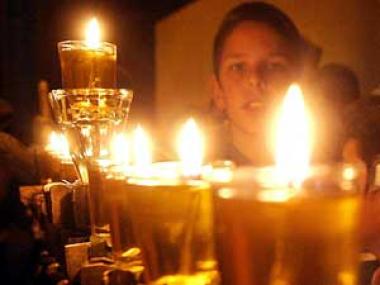
Other  decorative pagan mid-winter rituals  featured a wreath of evergreen with four candles. The candles were placed in each of the four directions to represent the elements of earth, wind, water and fire. Rites were performed  to ensure the continuation of the circle of life also symbolized by the evergreen wreath. Important  beliefs established by ancient traditions  still practised in part,  today.

Wreaths are, in essence, an eternal part of the festive season. In ancient Greece, a coral wreath was awarded to victors in sporting events, in much the same way that today's
Apollo wearing a laurel wreath
 Olympic champions are awarded gold medals. Wreaths were, and still are a sign of victory, and in Roman times, were often hung upon doors of those victorious in battle, thus advertising their status.
 -------------------

The Wichern Wreath
The Advent Wreath originated in Eastern Germany. Advent wreaths are round...having no beginning and no ending. It is also likened to the circle of life.There is evidence that suggests the Advent wreath was not invented until the 19th century. Johann Hinrich Wichern (1808–1881) was  a Protestant pastor in Germany  whose mission was to work among the poor. He is credited as the source of the modern Advent wreath. During Advent, children at a mission school  in Hamburg would constantly ask him when Christmas would arrive. In 1839, he built a large wooden ring with 19 small red and 4 large white candles fashioned from an old cartwheel  . A small candle was lit  every weekday during Advent. On Sundays, a large white candle was lit. The custom gained ground among Protestant churches in Germany and evolved into the smaller wreath with four or five candles known today.

 ---------------

Scandinavian wreaths feature candles, which illuminate the winter nights as everyone awaits the future light of Spring. It was once believed that the wreath and candles would encourage the Norse God of Light to turn the world back toward the direction of the Sun.


 In Scandinvian homes, the approach of Christmas is signified by getting out the Advent candlestick, which is often a little box with four candleholders embedded in moss and lingonberry sprigs. The first candle is lit on the First Sunday in Advent and allowed to burn down by one quarter. Next Sunday it is time for the second candle, and so on, until by the fourth Sunday the first candle has burnt right down and the last one was started.

 This is a peculiarly Swedish custom, but it was inspired by the “Advent trees” of Germany and became widespread in the 1920s. The Advent wreath, is a Christian tradition that symbolizes the passage of the four weeks of Advent in the liturgical calendar of the Western church. The Advent Wreath is traditionally a Lutheran practice that has spread to many other Christian denominations.
 ------------------


The time of Advent is coming to a close, and soon we will be celebrating the day of Christmas. Some might call it the day of Xmas. While many would feel the term "Xmas" is derogatory or secular, Xmas had it's place in earlier days.
The term "Xmas" instead of "Christmas" is Greek in origin. The word for "Christ" in Greek is "Xristos." during the Sixteenth Century, Europeans began using the first initial of Christ's name...the "X" of "Xristos"...in place of the word "Christ" as a shorthand version of the word "Christmas." Although early Christians understood that the "X"
was simply another form for the name of Jesus Christ, later Christians, who had no knowledge of the Greek language, mistook "Xmas" as a sign of disrespect. Eventually, however, "Xmas" came to be both an accepted and suitable alternative to the word "Christmas."
---------------


The word Advent has its origins in the Latin word adventus, which means arrival. The arrival of The Christ Child. Commercial enterprises have not been able to capitalize on the four weeks of Advent, but quickly jump to the lucrative profits of  Santa Claus and Xmas! However, the term Xmas may not be, as many feel, demeaning!
 -------------
     The celebration of Advent  is of fairly recent origin. It is only in our own time that attendance at Swedish church services on the first Sunday in Advent match attendance at the early morning service of Christmas Day. Church attendance tops  the year’s attendance figures in otherwise secular Sweden at this time for honoring the family, both living and dead, and for celebrating the rebirth of the Sun in the depth of winter.  The sun had disappeared about 30 days ago, and they hopefully awaited it’s reappearance.The people rejoiced by feasting, gift giving, visiting friends and kin, and remembering those family members who have died.
 ---------------
The Drinking Horn  Dec 25th


Yule marks the death of one year and the birth of another, as a turning of the endless cycle.Two hundred fifty years before the Roman/Christian calendar was accepted, the Runic Era calendar was followed.   December 20th marked  the arrival of winter. It marked a time of preparation as the long nights became a bit shorter. December 22nd marked the winter solstice, signaling as celebratory time of feasting and drinking when the sun returned to the world. In our modern world, this evolved into a celebration marking the birth of The ChristChild ,and our new beginning.
------------------
Yule marks the death of one year and the birth of another, as a turning of the endless cycle.
So, how many days...?  "Pretty soon!".