Sunday, December 18, 2011

Christmas Is Coming...

Christmas is coming...
Our Advent Calendar has one more week and Christmas Eve will soon be upon us. The celebration will be in full swing.

In ancient times, long before Christianity came to Scandinavia, "Jul" or "Yule" marked the peak of the winter solstice. It became a mid-winter celebration of the transition from the longest dark winter night to spring, December is the darkest month of the year in Scandinavian countries and marks the time when " the sun turns" and days began to lengthen. Christmas spirit lights up the dark nights with cheer and warmth. Norway, located in the north of Europe, has the longest and darkest winters in Europe. It’s also thought to be the least church-going country in Europe. Jul was celebrated as a drinking season earlier in the year, but Norway’s King Haakon I moved the heathen custom to December 25th to celebrate the birth of Jesus. -------------- Early Yuletide, meaning "the turn of the sun" or the winter solstice ,welcomed the light of the ceremonial candles and the abundance of fresh meat in this time of the year to slaughter the animals--which made more sense in that subsistence economy then feeding them through the winter. It was also a time of warmth as the men harvested the Yule Log. This ceremonial log was originally an entire tree that was brought into the house with great ceremony. The butt end was placed into the hearth while the remainder of the tree stuck out into the room.. The tree would be slowly fed into the fire and timed to last the entire Yule season. --------------------- The Christmas tree would be decorated by the adults, the children would not be allowed to see it until the appropriate time. However, the children had a task of preparing a bowl of porridge to be given to the little gnome who lived in the attic or in the barn. If ignored, this little elf would be capable of great mischief during this Yule season and the upcoming spring season.

The traditional Scandinavian cuisine for the Christmas Eve meal might be a variety of cold and warm delicacies like fish, sausages, ham, salad and desserts. Herring and lutefisk are traditional fish dishes. Glogg and schnapps would be the beverages of choice as everyone enjoys the evening, anxiously awaiting the "Julenisse", a Scandinavian version of Santa Claus. This welcome visitor has no reindeer, perhaps a sleigh pulled by a goat. He also carries a load of simple gifts in a bag on his back for all good Scandinavian boys and girls.

-----------------------------------

Christmas Day will be marked with a journey to church to light candles and lay wreaths on family graves. The tradition of layng a spruce wreath and lighted candles or lanterns began in the 1900s, following World War II. Danish Christmas trees were decorated by Danish flags after the war. During the Nazi occupation, Danes were forbidden to display their flag and after the war, they used it as a Christmas decoration. This later spread to the rest of Scandinavia. ----------------- While it appears that we might not have a white Christmas here, areas of Scandinavia should find the ground snow-covered in the countryside with a moonlit night to help guide the Julenissen on his journey.

Jeg er så glad hver juleveld!

GOD JUL!

Wednesday, December 7, 2011

The Shortest Day Of The Year Is....

Our nights are getting longer as we count down the days to Christmas. December 6th marked the remembrance of St. Nicholas, a legendary person of history. This saint is not too well-known in Scandinavia, but is remembered as a generous soul to children, the poor, and men of the sea. The stories of St. Nicholas become intertwined with that of our famous Santa Claus, who will be arriving soon. Our advent calendar is progressing well. For those of you who have one for the children, you might enjoy an adult version, A very popular one is an Orange and Cloves calendar . All one needs is a fragrant orange, and the needed number of cloves to mark each remaining day to Christmas. -------------- To made this aromatic calendar, just insert the stalk end of the cloves into the unpealed orange in a pattern designed by you. Use a toothpick to design your pattern while creating the holes to insert the cloves. These "Calendars" can be placed anywhere you wish. Each day, pull out a clove and refresh the room with the pleasant aroma of holiday preparations.
-----------------------------------------------------
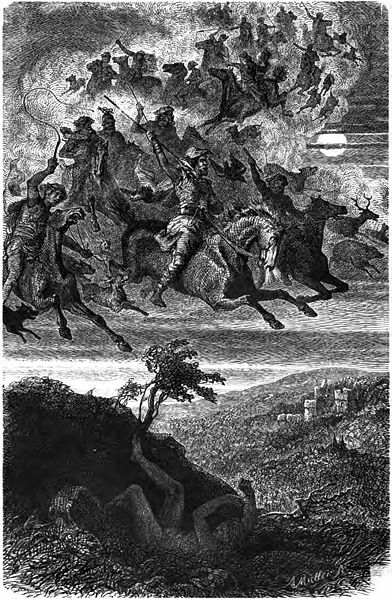
December 13th marks the darkest and shortest day of the year. This day earned a mark on the Scandinavian calendar, which was called a primstav--a wooden calendar stick. On this day Lussi langnatt ( Lucy Longnight), as such, Åsgårdsreia (Asagard parade--(a trail of unsettled dead souls) became a tradition. These restless souls would travel from farm to farm seeing if people were preparing for Christmas. If not, these wandering souls would vandalize the farm.. To protect themselves, the farmers would paint tar crosses over the doors of their houses and barns.On this long night, animals gained the ability to speak and were expected to be generously fed. This feasting was also expected in the farmer’s family. -------------------------------------
Saint Lucia Day is one of few saint days observed in Scandinavia and her story stretches back to the time of the Vikings and the Roman Empire. Lucia was a brave young Sicilian woman who heard of the persecution of Christians by the Emperor Diocletian and decided to take action. She gave one Christian family her entire dowry. This angered her betrothed husband, who then told authorities that Lucia secretly practiced Christianity. Lucia, who died a martyr’s death was much admired for her courage, generosity and faith. Her memory was not forgotten. ----------------------------------------------
It was not until after World War II that the modern celebration of Lucia in Norway was imported from Sweden. Luciadagen became a day to commemorate martyrs on the anniversary of their death ( or birth into heaven). In tradition, the eldest daughter of the family arises to treat her family in the early morning of December 13th bearing treats and wearing a crown of candles.
The day of feasting begins. Christmas is coming.

Monday, November 28, 2011

Prepare Ye, The Way!

The day of "Thanks" is over and now it’s time for "Giving". It begins earlier every year, but all stores were ready, stocked and open for customers on "Black Friday", the day after Thanksgiving. In ancient times, there was a festival consisting of a mid-winter sacrificial feast celebrated with bright lights marking the transition from dark winter to spring and summer. The celebratory beverage was known as jul. This has evolved into today's julmust, a soft drink that, in Sweden, outsells Coca-Cola during current Christmas seasons.
--------------------
This ancient festival became known as Christmas, a time for celebrating the harvest, fertility, birth and death. In the 900’s, King Haakon I decided that the heathen custom of drinking jul (Yule) was to be moved to December 25th, in honor of the birth of Jesus Christ, and gradually, the pagan feast was Christianized. The name Jul was retained, but the holiday was dedicated to Jesus Christ. Christmas became a mixture of ancient heathen and Christian traditions. In Sweden, and other countries, great joy comes in the preparation. The "Gettting There" becomes almost as much a joy as the real thing!
---------------------------------------------------- Advent is the Christian season marking the preparations for Christmas. In Norway, it is celebrated with advent candles. Usually four candles set in a candelabra. The first is lit on the first Sunday of Advent-four Sundays before Christmas. Another candle is lit each Sunday, making the "Countdown" to Christmas Eve, December 24th. The final, middle candle is lit December 25.
------------------------------------------------------------------ In the Scandinavian countries of Norway, Sweden, Iceland, Denmark and Finland, there is a tradition of having a so-called Advent calendar, or Julekalender. Over the years, there have been several different kinds of julekalender marking the days to Christmas. Some are directed at adults while others are designed for the children. Many are woven into TV Shows that begin on December 1 and end on the 24th. The Julekalender was first aired on Swedish TV in 1960 with the program called Joulukalenteri.
---------------------------- These "count-down" calendars often featured 24 windows that would be opened one-a-day, featuring a biblical saying, gift, or maybe a treat. The first widespread advent calendars evolved from a collection of 24 gingerbread cookies with numbers made of melted sugar!. Today, most Swedish children get a Swedish Television Calendar based on a serialized story that they can follow as they open each window while viewing the show.
-------------------------------
So, the count-down to Christmas has begun. Last Sunday marked the lighting of the first Advent candle with only three more to go!

Many of us have given daily gifts counting down The Twelve Days of Christmas, while other countries enjoy doubling their fun!

Friday, November 18, 2011

When is Thanksgiving Day in Scandinavia?

Every American schoolboy and schoolgirl is fully aware of pilgrim hats and Indian costumes when November comes. Plymouth Rock and the Mayflower are common knowledge as they happily take part in the annual pagentry. Looking for celebrations of this event in overseas countries is a different story. Thanksgiving Day is a North American celebration, however the sense of appreciation for a bountiful harvest is shared by all. ---------------------- One mention of "Thanksgiving Day" is noted in Swedish tradition, however it is a Sunday in the Swedish ecclesiastical year ( the second Sunday of October) , and if one does not go to church, it isn't noted at all! On this day, the Swedish church is decorated with produce of the harvested apples, potatoes, carrots and the like, while twigs and colored leaves decorate the altar. The collection might be sent to relief organzations to aid the needy.
-----------------
Throughout history, mankind has celebrated the bountiful harvest with thankful ceremonies. Before the establishment of formal religions, many ancient farmers believed their crops contained spirits which caused the crops to grow and then fade. They believed that these spirits would be released when the crops were harvested.
--------------------
Canadians celebrate their days of Thanks each year on the second Monday of October (which is Columbus day in the US). The Canadian celebration is not based on a harvest, but for the survival of travellers who arrived after a long journey from England, having struggled through a voyage of storms and icebergs to the area they called New France. Martin Frobisher, an explorer, was tryingto find a northern passage to the Pacific Ocean. These French settlers typically had feasts at the end of the harvest season.
This painting " The Order of Good Cheer", a 1606 print by Christopher Jeffreys depicts food carriers in Canada during their harvest festival.
-----------------------
Harvest festivals have been a part of history. Ancient Greeks worshiped many gods and goddesses. The goddess of grain was Dementer and honored in a festival on October 4th. The Egyptians celebrated their harvest festival in honor of Min, their god of vegetation and fertility. This festival was held in the springtime, the Egyptian harvest season. They wept and pretended grief at their harvest as they tried to deceive the spirits that inhabited the crop. They feared the spirit would become angry when the corn was cut away and begged forgiveness for having to take the spirits home away.
-----------------------
Here in America, our "Thanksgiving Day" centers around the autumn of 1621 as 53 surviving pilgrims celebrated the sucessful hunt, as they did in the Old Country, along with 90 Native American indians who had helped the small band of people survive the past year. Hunters were sent out to harvest five deer that provided the three day feast for the celebration. This print is entitled " The First Thanksgiving" by Edward Winslow".
------------------------------
The first recorded religious Day of Thanksgiving was held in 1623 to celebrate a providential rainfall. The tradition of our American Thanksgiving Day was signed into law by President Abraham Lincoln in 1863. Our festival has become one day to give thanks and the day before "Black Friday" with happy days ahead! 'Tis the season!
Happy Thanksgiving!

Monday, November 7, 2011

Where Are We?

Sometimes, driving around country roads turning left and right causes the driver to, occasionally, not believe "The Navigator's" decisions on what direction or where we are! ( She's not ALWAYS right!) One fun trick is to point the hour-hand of the wristwatch at the sun. One-half-way between that point and 12 will be south. It works! So, how did those Vikings travelling across the North Atlantic day and night manage to get where they wanted to go? Not too many had a wristwatch, so what were their navigational aids? And what happens in stormy or foggy weather?

While they were near shore, the Vikings could easily follow seabirds, watch wave patterns, stars and the sun-position. Leaving the shorelines and following the normal east-west routes required some navigational skills. The sun provided the basic aide, but cloudy and foggy days, combined with stormy nights with winds changing directions would leave one to believe that some discoveries were, in fact, accidental happenings.

----------------------

One Icelandic saga describes an occasion, during stormy, snowy weather, King Olaf discussed their ship direction with Sigurd. Checking Sigurd's answer, Olaf "reached into his tunic and withdrew a stone". "Looking at the cloud-filled sky and the changing brightness of the stone as he turned it in his hand, he pointed out the direction to continue their travels". This stone is now known as a "sunstone", a stone commonly found in Iceland.

-----------------------

In 1967, Thorkild Ramskou, a Danish archaeologist, speculated that Viking sunstones might have been Icelandic spar, a clear calcite crystal. Calcite acts as a prism, splitting incoming rays of light in two, known as birefrigence. This property makes the crystal light or dark when held up to light of different polarizations. Viking legends mention a stone that , when held up to the sky, revealed the position of the sun, even on overcast days or when the sun was below the horizon.

________________

To use the crystal, the Vikings would have held the stone up to the center of the sky ( from their perspective). When sunlight hit the crystal, that light became polarized and broken into the two beams. Researchers have found that if they put a dot on top of the crystal and look from below, two dots appear, due to the refraction of the Icelandic spar. They could then pinpoint the sun by rotating the crystal until both dots line-up and were of equal brightness. So, Olaf had a sunstone,and while rotating the crystal and balancing the light and colors, he found the position of the sun.

-------------------------

The optical effect of this crystal appears to be due to reflections from the stone's property of red copper, imbedded in the form of small scales, which are hexagonal, rhombic or irregular in shape.

----------------------------

All this before the age of the compass, and the well-known electronic voice of Mrs. Garmin " Turn left at the corner" and "recalculating". We've come a long way, sometimes accidentally.

Thursday, October 27, 2011

Eureka! I've Got it!

Computer scientists from Sweden and the United States have applied modern-day techniques to decode a 250-year old secret message! The Copiale Cipher . The original document was written in the late 18th century and discovered in the East German Academy after the Cold War. This 105 page document has kept its secret, all these years..until now!

This year, University of Southern California Viterbi School of Engineering computer scientist Kevin Knight and collegues Beata Megyesi and Christiae Schaefer of Uppsala University in Sweden tracked down the document and cracked the code. Some of the cryptic letters were Roman, while others were Greek, and the rest were abstract symbols and "doodles".

---------------------------

The book, bound in gold and green brocade dates back to a time between 1760 and 1789, contained about 75,000 characters of 90 different cipher letters, including the 26 Roman letters, all in very neat handwriting.. "Historians believe that secret societies have had a role in revolutions, but that is yet tobe worked out, and a big part of the reason is because so many documents are enciphered" according to Kevin Knight, a U. of California code-expert. Computations and a good chunk of the translation has been decoded, revealing rituals and political leanings of a German secret society. Knight called upon scholars from Uppsala University in Sweden. This institution is the oldest university in Scandinavia, founded in 1477. It consistently ranks among the best universities in Northern Europe and is considered on of the most prestigious institutions of higher learning in Europe.

------------------------

After many hours of decoding, the team realized that some characters were inserted to mislead, while others could be grouped forming words. Using different languages, the German language, when used, resulted in partial understandable text..Sorting through the Roman, German and other language symbols, the document finally revealed the rituals and political leanings of a Secret German Society, a society that had a strange obsession with.... eye-balls, plucking eye-brows, eye surgery and ophthalmology!

-----------------------------------

The Copiale Cipher case was cracked! This 18th-century manuscipt of 150 precise pages, written in thoughtful coded symbols and letters turned out to be a German Masonic secret society known as the "Occult Order." Decoded, the secret document documented procedures of meetings, and secret lessons for apprentice initiation. One might question the reason for the elaborate effort of secrecy. But it would take a team of Californian Americans and Swedes from Uppsala University to solve the riddle.

If you can read this. you might make the team!

Friday, October 21, 2011

Hvor mye koster det?

How much is that?
Back "in the day", Wisconsin became aware of a new spread called "Margarine" , but because it competed with the Dairyland Favorite "Butter", it was illegal for Wisconsin stores to sell it. So, if we wished to buy the much cheaper product, we had to go "out of state!" Living next to the Mississippi River made it easy to drive over the river into Iowa and buy the "illegal" and cheaper margarine. Apparently, similar shopping is happening to Norwegian shoppers , who are going across the border into Sweden to buy cheaper products. Swedish stores on the border are doing well!
This is a typical Swedish store open for business.
-------------------------------
Norwegian grocery stores have the highest prices in Europe and the worst selection of goods, according to comsumer advocates. A government study-group is trying to discover the reason. Food producers, retailers and wholesalers all blame each other. " The reality is that we have four major chains that control the entire Norwegian market" says one spokesperson of the group. Another finding is that when volume is high and suppliers wish to have their product displayed and sold in a store, the supplier might offer a "bonus" to the retailer, which the retailer tends to keep, instead of passing it on to the consumer. It has been said that the grocery chains' owners tend to be among the wealthiest in Norway. So, let's go shopping in Sweden!

----------------------

In Sweden, grocery prices are half the prices paid in Norway. A thin pack of 10 slices of bacon in Norway costs NOK 30 (USD $5.30). In Sweden it's one-third that price. A liter of milk costs more than NOK 14 ( USD $2.50)in Norway. Norway prices:a dozen eggs are at least NOK 39 (USD 7). A loaf of bread costs NOK 30, but can go as high as NOK 40 ( $7.10 USD)

Swedish stores have a wider choice of produce.

---------------------

There may be other reasons, as well.High tariffs on imported products protect the local producers. Norway's farmers have a very strong lobby and receive state aid. "Norwegian agricultural policy helps keep the cost of Norwegian produce high," Christian Rygh, of the Norwegian agricultural authority told the newspaper Aftenposten. All told, farmers receive an annual pay raise of NOK 25,000 on the average ( nearly USD $5,000) and are the most highly subsidized farmers in the world. This steep price of local agricultural products allows merchants to jack up the prices, while Norwegians are not necessarily price-conscious.

-----------

Still other reasons: Norway has small grocery stores on every corner and this adds to distribution costs. These shops are more expensive and are less profitable that the major chain stores that are found in Sweden.

IKEA. A popular and well-known Swedish store.

----------------------

Norway is the world's third largest oil exporter, and a major exporter of natural gas. This high level of income might correlate with higher price levels. And again, Norwegians do not tend to be price-conscious...But when the food-bill goes up, a trip across the border to buy cheaper groceries and meat products can save some NOK!

So, it's across the border to Sweden. Check the customs sign. Anything to declare?